
Last updated
Losing a loved one is difficult enough. Liquidating their physical estate should not add to your stress. When people inherit a luxury watch, such as a vintage Rolex, Patek Philippe, or Audemars Piguet, they are often dealing with grief, complex family dynamics, and a complete lack of knowledge about the secondary watch market. Furthermore, legally selling an estate asset involves strict legal and tax regulations that must be followed carefully.
By educating yourself on the exact laws in Florida, you can easily ensure a smooth, legal, and highly profitable transaction. At Florida Watch Exchange, we specialize in helping families accurately appraise and sell estate timepieces. Here is exactly what you need to know about the local laws, the federal taxes, and the appraisal process in Florida to ensure you get a fair and legal payout for your inherited luxury watch.
In This Guide
Navigating Florida Probate Law: Establishing Legal Ownership
Before an heir can legally sell a luxury watch, they must have clear legal title to it. Florida probate laws are firmly established in Chapters 731 through 735 of the Florida Statutes. These strict rules govern how estates are formally administered, how personal representatives are legally appointed, and how physical assets are distributed after death.
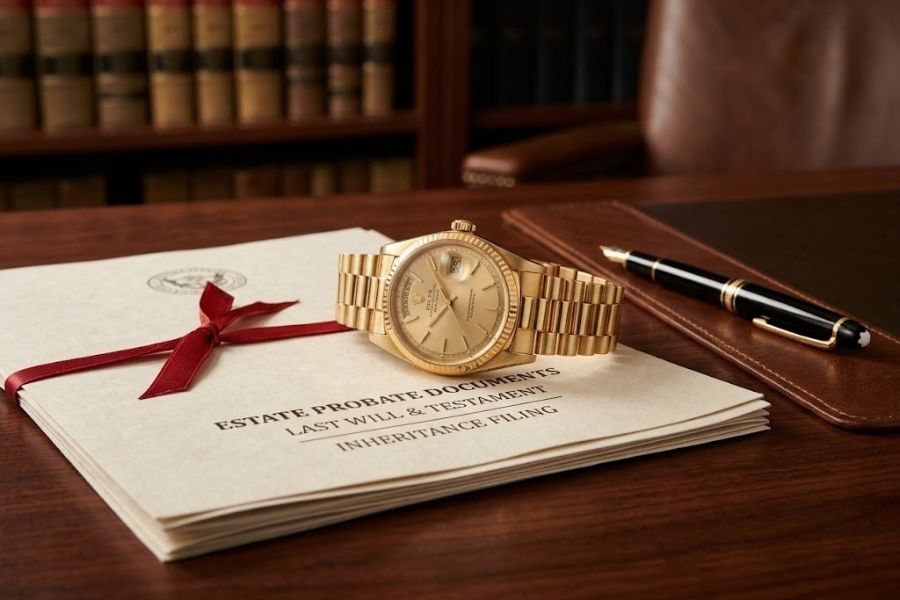
Probate is the court-supervised legal procedure through which a deceased person’s entire estate is administered. Jurisdiction for this process is exclusive to the circuit court in the exact county where the decedent was legally domiciled at the time of their passing. Probate is legally required in Florida when the decedent leaves behind solely owned assets with absolutely no specific beneficiary designation. Because a luxury watch is a piece of tangible personal property that does not have a formal title or a named beneficiary attached to it, it must typically go through this legal process before ownership is officially transferred to an heir.
If the watch is part of a larger estate, it cannot be legally sold by a family member until the estate officially goes through probate, unless the watch was previously placed securely into a Living Trust. The Personal Representative, often called the Executor, is officially appointed by the probate judge. They are the only person who can authorize the legal sale of the watch on behalf of the estate. Alternatively, the probate court must formally distribute the watch to a specific heir before that individual heir has the legal right to sell it on the secondary market.
Florida provides several distinct probate alternatives depending entirely on the specific financial circumstances of the estate:
- Formal Administration: This is the most thorough process involving full court oversight. It is legally required for estates worth over $75,000 or when the decedent passed away less than two years ago.
- Summary Administration: This is a simplified and much faster form of probate. It is strictly intended for smaller estates under $75,000 or if the decedent has been deceased for over two full years.
- Disposition Without Administration: This rare, highly specific process allows for the immediate reimbursement of final expenses from the estate’s assets without formal probate, but it applies only in very limited circumstances regarding funeral costs and medical bills.
Disclaimer: We highly recommend consulting a licensed estate attorney to properly navigate these strict rules. For more comprehensive legal guidance, you can review the Florida Bar Consumer Pamphlet on Probate.
The Transaction: Florida Secondhand Dealer Laws
When you are finally ready to officially sell the inherited watch, you might be very surprised when the buyer asks for your government-issued ID and a physical thumbprint. Explaining exactly why this happens is incredibly important to us. It builds transparency and proves you are working with a legitimate, law-abiding business rather than an unregulated, shady pawn shop.
To prevent the illegal sale of stolen goods and actively protect the public, the state strictly regulates secondhand dealers. This broad legal category automatically includes luxury watch buyers and professional jewelers. Under Chapter 538 of the Florida Statutes, all secondhand dealers must complete a specific, highly detailed transaction form at the exact time of the transaction.
When purchasing a watch from the public, Florida secondhand dealers are legally required to record the following information:
- Detailed Item Description: A complete and accurate description of the goods acquired, including the brand name, model number, manufacturer’s unique serial number, and any other identifying physical marks.
- Photographic Evidence: Clear digital photographs of the goods that distinctly show the item being purchased.
- Seller Identification: The seller’s full legal name, current residential address, verified workplace, and phone numbers.
- Physical Characteristics: The seller’s physical description, including height, weight, date of birth, gender, and race.
- Fingerprint Verification: The right thumbprint, completely free of smudges and smears, of the person from whom the goods were acquired.
Furthermore, the dealer must strictly maintain a hard copy of this transaction form on the registered premises for at least one full year, and they are legally required to keep the records for not less than three years. Unless other arrangements are officially agreed upon with local law enforcement, the dealer must deliver a complete record of the transaction to local officials within 24 hours of acquiring the secondhand goods.
You can read the full text of these stringent legal requirements at the Florida Legislature Chapter 538 page. By strictly adhering to these protective laws, Florida Watch Exchange actively protects our clients, deters luxury theft, and successfully ensures every single transaction is completely secure.
A Note on Security
We understand that providing a thumbprint and deeply personal identification can initially feel intrusive. However, these specific Chapter 538 regulations are designed entirely to protect the integrity of the luxury watch market. It mathematically guarantees that the pieces we buy and sell have a clean, legally verifiable history.
The Tax Implications: Federal vs. Florida State Law
Taxes are a massive, stressful concern for families liquidating high-value estate assets. Fortunately, Florida is one of the absolute most tax-friendly states in the entire country for this exact scenario.
First, Florida has absolutely no state income tax and zero state capital gains tax. This simple fact means the state government will never take a percentage of your watch sale when you legally liquidate the physical asset.
Second, the federal tax implications are often much better than terrified heirs initially realize due to a powerful legal rule known as the “stepped-up basis.” Under Internal Revenue Code Section 1014, when a person legally inherits an asset, its tax basis is automatically stepped up to its Fair Market Value on the exact date of the decedent’s death.

Here is a highly practical example. If your uncle bought a Rolex Submariner in 1985 for $1,500, and it is officially worth $18,000 on the exact day he passes away, your new tax basis is $18,000. If you legally sell the watch to a dealer a month later for $18,000, you owe zero federal capital gains tax because there was no financial gain from your new stepped-up basis. We highly recommend consulting directly with a certified public accountant or a local Florida estate attorney to verify exactly how this rule applies to your specific inheritance.
The Appraisal Standards: FMV vs. Retail Replacement
Inherited items often come with very old insurance appraisals tucked quietly inside the original box. It is absolutely vital to understand the difference between an inflated insurance value and a realistic cash liquidation value to prevent feeling deeply frustrated during the sale. We cover this extensively in our guide on understanding professional Rolex appraisals in Florida, but here is a quick breakdown specifically tailored for estate purposes.
| Appraisal Type | Primary Purpose | Value Expectation |
|---|---|---|
| Retail Replacement (Insurance) | Used exclusively by insurance companies to replace the watch at full retail price if it is lost or stolen. | Highest Value. Often inflated beyond secondary market realities to safely cover future price increases. |
| Fair Market Value (FMV) | Required by the IRS for estate tax purposes. It represents the price a willing buyer pays a willing seller. | Realistic Market Value. Reflects exactly what the watch actually trades for today between private parties. |
| Cash Liquidation Offer | What a professional dealer will pay immediately in cash today to acquire the inventory. | Wholesale Value. Leaves necessary financial room for dealer margins, mechanical servicing, and warranty risks. |
Formal estate appraisals should ideally follow Uniform Standards of Professional Appraisal Practice guidelines. However, for a simple, fast liquidation where the family just wants to divide the cash fairly, a highly accurate market offer from a trusted dealer is usually what the heir is actually seeking.
How to Sell an Estate Watch to Florida Watch Exchange
If you have recently inherited a luxury timepiece and the legal probate process has officially cleared you to sell it, the next step is finding a trusted, local buyer. Here is exactly how our straightforward, highly secure process works.
- Request a Quote: Visit a luxury watch store in Miami and securely submit clear photos of the watch, the original box, the warranty card, and any associated vintage paperwork.
- The Evaluation: Our highly trained experts will evaluate the current market value. We meticulously check the serial numbers and carefully assess the mechanical condition. If the watch has been customized by previous owners, you can read about how that heavily affects the value in our post on the true financial cost of adding aftermarket diamonds to watches.
- The Offer: We present a highly competitive, absolutely no-obligation cash offer based purely on real-time secondary market data.
- The Paperwork: We collect your ID and physical thumbprint in incredibly strict compliance with Florida Statutes Chapter 538.
- Immediate Payment: Once the legal paperwork is complete, you receive highly secure and immediate payment via bank wire transfer or certified check.
Frequently Asked Questions
Liquidate Your Estate Watch With Complete Confidence
Selling an inherited luxury watch absolutely does not have to be a stressful or legally confusing experience. By carefully understanding Florida probate and secondhand dealer laws, you can confidently approach the transaction. If you are ready to explore the true financial value of your estate timepiece, reach out to the professional experts at Florida Watch Exchange today.